
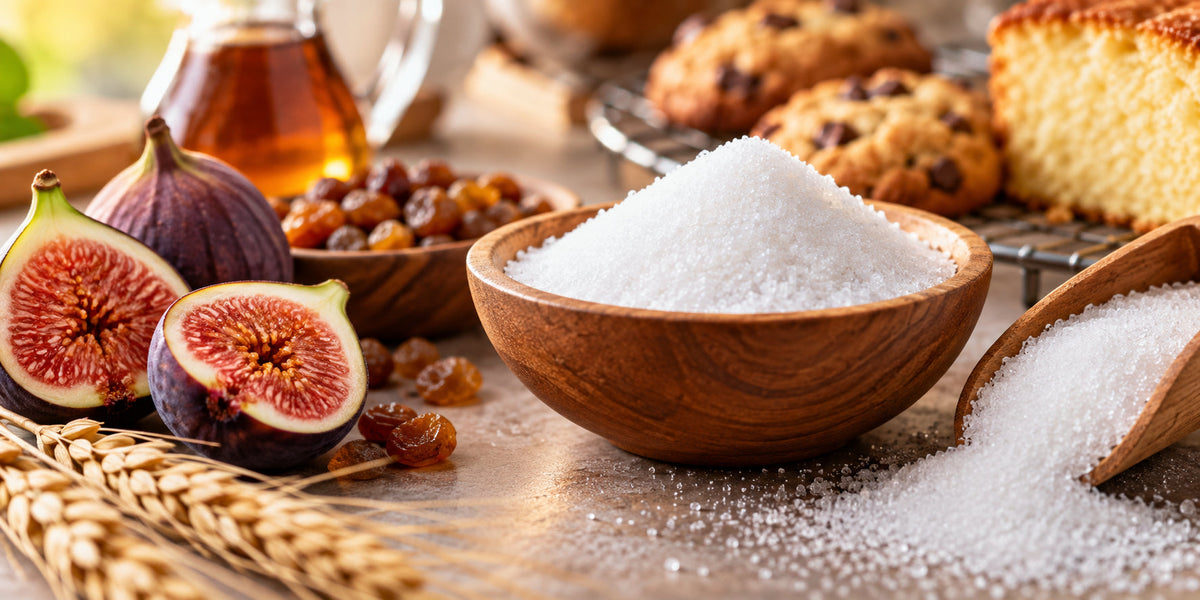
Allulose: The real sugar changing the kitchen
Allulose is currently carving out a firm place for itself in the modern kitchen. It’s no wonder: in many applications, it tastes and behaves surprisingly similarly to sugar—it can caramelize, brown, melt, and is highly water-soluble. At the same time, allulose differs significantly from standard table sugar in how it is metabolized.
The exciting part: Allulose is neither an artificial sweetener nor a sugar alcohol. Allulose is a real sugar—more specifically, a rare monosaccharide (simple sugar).
And that is precisely what makes it so interesting for the kitchen.
Allulose combines many of the technological properties of sugar with a significantly different metabolic effect.
What is allulose?
Allulose, also known as D-allulose or D-psicose, belongs to the group of monosaccharides. Chemically, it is closely related to fructose: allulose is a so-called C-3 epimer of fructose. It therefore has the same molecular formula as glucose and fructose—C₆H₁₂O₆—but differs in the spatial arrangement of a hydroxyl group.
This might sound like a minor detail at first. For the body and for the kitchen, however, this small structural change makes a big difference.
Allulose belongs to the group of so-called "rare sugars." It occurs in nature, albeit only in very small quantities. It has been found in, among other things:
- dried figs
- raisins
- blueberries
- figs
- maple syrup
- molasses
- a few other plant-based foods
The natural amounts are so small that allulose is not simply extracted from figs or raisins for widespread use. For industrial production, it is typically manufactured from fructose through enzymatic conversion (epimerization).

Allulose is a real sugar—and that is the crucial point
When we talk about sugar, most people think of table sugar, i.e., sucrose.
Allulose is something different—but chemically, it is actually a sugar.
This distinguishes it from many well-known sugar substitutes:
- It is not an artificial sweetener like aspartame.
- It is not a sugar alcohol like erythritol or xylitol.
- It is a monosaccharide, i.e., a simple sugar.
- It possesses many properties known from sugar in the kitchen.
It is exactly this combination that makes allulose so interesting.
Because when cooking and baking, sugar is about much more than just sweetness. Sugar influences the color, aroma, texture, moisture, volume, freezing point, and structure of a food product.
While many intense sweeteners can provide sweetness, they cannot technologically replace sugar entirely. Allulose can do significantly more.
How is allulose metabolized in the body?
This is where one of the biggest differences compared to classic sugar lies.
After consumption, a large portion of allulose is absorbed in the small intestine. However, it is only metabolized to a very small extent in the human body. A large proportion is then predominantly excreted unchanged in the urine. EFSA documents describe an absorption rate of approximately 70–85%, while only small amounts are metabolized or fermented.
Therefore, allulose provides significantly less usable energy than sucrose. European dossiers describe an energy content of less than 0.4 kcal per gram; approximately 0.2–0.4 kcal/g is frequently stated.
And what about insulin?
An important distinction is necessary here.
It is not accurate to say that allulose is "metabolized via insulin." Allulose is processed differently precisely because the body does not use it as a primary energy source like glucose.
Accordingly, studies in humans show only a very low glucose and insulin response to allulose. In controlled studies, it has even been observed that adding allulose to a sucrose load can reduce the subsequent glucose and insulin response.
However, this does not mean that allulose automatically possesses a medical effect or treats diabetes. Research into long-term health effects is ongoing. Even studies do not arrive at the same conclusions on all points.
For us, one thing is particularly interesting:
Allulose can provide sweetness without behaving in the body like an equivalent amount of table sugar.

Why is allulose so exciting for cooking and baking?
This is where allulose demonstrates its great strength.
Anyone who has ever baked with erythritol or high-intensity sweeteners knows the problem: sweetness can be replaced relatively easily—but the technological functions of sugar cannot.
Allulose, on the other hand, provides many of the properties that make sugar so valuable in recipes.
1. Allulose is highly water-soluble
Allulose dissolves well in water and is therefore suitable for liquids as well as for doughs, creams, sauces, and other preparations. Solubility increases significantly with temperature. Measurements show very high water solubility, especially at higher temperatures.
This makes allulose practical for:
- drinks
- sauces
- creams
- desserts
- ice cream
- jams and fruit preparations
- doughs
- cakes and cookies
2. Allulose caramelizes
It gets even more exciting when heated.
Allulose can caramelize, developing typical brown hues and caramelly flavor components. Studies show that under appropriate conditions, allulose is very reactive in browning and caramelization reactions.
This is a decisive advantage over many sweeteners.
Because for those who want a golden-brown cake, crunchy cookies, or a beautiful caramelized surface, it takes more than just sweetness—it takes chemical reactions when heated.
And this is precisely where allulose can score points.
Why does allulose brown more intensely? The Maillard reaction explains it
A particularly interesting feature of allulose is its strong involvement in the Maillard reaction.
Simply put, the Maillard reaction is the reaction between reducing sugars and amino compounds that provides the typical brown colors and many of the delicious roasted aromas when heated.
It is, among other things, responsible for:
- the golden-brown crust of bread
- the color of cookies
- roasted aromas
- complex baking aromas
- the brown surface of many baked foods
Allulose can develop color faster than conventional sugar.
Recent studies on cookies also confirm accelerated browning and increased formation of Maillard reaction products with increasing levels of allulose.
What does this mean for the kitchen?
When a recipe is baked with allulose, you should keep an eye on the temperature and baking time. A cake, for example, might already be significantly more browned on the outside while the inside is not yet fully baked through.
This is not a fault of the allulose—it is one of its special properties.

Allulose in baking: What should you keep in mind?
In principle, allulose can be used in a great many recipes that normally contain sugar.
It is particularly interesting for:
🍪 Cookies
Allulose provides sweetness while simultaneously supporting the desired browning. As a result, cookies can develop a color and aroma that are difficult to achieve with many other sugar substitutes.
🍰 Cakes
Allulose can take over a portion of the technological functions of sugar while simultaneously providing beautiful browning.
Because it reacts differently than sucrose, you should experiment a bit with temperature and baking time.
🥞 Pancakes and waffles
The rapid browning of allulose can be particularly interesting here. The surface can become beautifully golden-brown and develop roasted aromas.
🍮 Desserts and creams
Thanks to its good water solubility, allulose is also suitable for liquids and creamy preparations.
🍦 Ice cream and frozen desserts
In addition to its sweetness, allulose possesses physical properties that can be interesting for frozen foods, including an effect on the freezing point.
Allulose is not a "fake sugar"
That is precisely what fascinates us at TOBIO about this special sugar.
Many sugar substitutes only solve part of the problem:
They can be sweet—but they do not behave like sugar.
Allulose takes a different path. It is:
✓ a real sugar
✓ a naturally occurring molecule
✓ water-soluble
✓ caramelizable
✓ heavily involved in browning reactions
✓ interesting for baking and cooking
✓ significantly lower in energy than sucrose
And at the same time, it is only metabolized to a small extent in the human body.
Of course, this is not a blank check to eat unlimited amounts of sweet foods. Even with allulose, a high intake can lead to digestive discomfort. As with many carbohydrates, individual tolerance is therefore relevant.
But from a technological perspective, allulose is something completely different from a sweetener that merely "tastes sweet."
It is a sugar that can behave like sugar in the kitchen—while the body treats it very differently.
Allulose in the EU: Why can't we sell it yet?
Now comes the slightly less delicious part of the story.
Although allulose is already used internationally in various countries, the situation in the European Union is currently different.
Allulose is currently not yet approved as a Novel Food in the EU and is not yet on the Union list of authorized novel foods.
For companies, this means: Allulose may not currently simply be placed on the EU market as a food ingredient.
For novel foods, the EU requires a scientific safety assessment followed by a formal authorization. EFSA conducts the scientific risk assessment, while the European Commission manages the authorization process. Following a positive EFSA assessment, a decision is made regarding inclusion in the Union list.
Who is driving the allulose authorization forward?
The authorization is not being driven by a single organization.
Several companies have submitted applications for allulose as a novel food in recent years. These include, among others:
- CJ-Tereos Sweeteners Europe
- Petiva Europe
- Samyang
- Tate & Lyle
- SAVANNA Ingredients
The European Commission lists these applications in its official overview.
The companies provide the necessary scientific data; EFSA evaluates safety, and the European Commission coordinates and decides on the authorization.
What has happened so far?
The process has been ongoing for several years.
The EFSA assessment of the Petiva application from 2015 is particularly interesting. At that time, EFSA concluded that the safety of D-allulose could not be established based on the available data because requested additional information had not been fully provided by the applicant. This is important: EFSA did not determine that allulose is unsafe. Rather, the specific assessment could not be successfully concluded due to missing data.
Other applications remain in the regulatory process. The current status also shows: Allulose is not yet authorized in the EU.
When will allulose be authorized in the EU?
We want to be honest here:
There is currently no officially confirmed authorization date.
In principle, the process stipulates that after a valid request, EFSA carries out a scientific assessment. Following the publication of a positive EFSA opinion, the European Commission generally has up to seven months to present an implementing act to the responsible committee. Only after further proceedings and the publication of the authorization can the novel food be legally placed on the market in the EU.
Therefore, we prefer to wait for an actual authorization rather than a predicted date.
May a consumer own allulose or bring it from abroad?
An important distinction is necessary here.
The Novel Food regulations are aimed specifically at placing on the market by food business operators. The European Commission explicitly states that a food business operator may only place a novel food on the EU market after it has been authorized accordingly.
This does not automatically mean that mere possession of a pack of allulose by a private individual would be illegal.
Anyone purchasing allulose in a country where it is legally permitted to be sold as a food can, in principle, purchase or bring it along for private personal use – although general import regulations must also be observed for imports from non-EU countries.
The situation is different for companies:
An Austrian or other EU company may currently not simply sell allulose as food in the EU or use it in their own food products, as long as the necessary EU authorization is missing.
This is precisely why we at TOBIO are not yet able to offer allulose – even though we find the product technically and culinarily very exciting.
Why we at TOBIO support allulose
At TOBIO, we work intensively with food, ingredients, and their function in the kitchen as well as their effect on the human organism.
And with allulose, we find something particularly exciting:
It does not try to imitate sugar with a completely different substance. It is a sugar itself.
The difference lies in what the body does with it.
For the kitchen, this means:
- Sweetness
- Water solubility
- Mass and volume
- Browning
- Maillard reaction
- Caramelization
- Interesting texture
- Versatile use in cooking and baking
For the metabolism, it simultaneously means that allulose is only utilized as an energy source to a very small extent and is largely excreted again.
It is precisely this combination that makes allulose so interesting to us.
We are therefore excited to see what future scientific and regulatory developments will bring.
As soon as allulose may be lawfully placed on the market in the European Union as a food ingredient and the corresponding framework conditions are established, we would love to offer it at Tobio.
Until then, the following applies:
For us, allulose is one of the most exciting sugars of the next generation – a real sugar with properties we would want from a modern sugar.

Allulose – Rethinking Sugar
Allulose is not an artificial sweetener and not a sugar alcohol. It is a real, naturally occurring monosaccharide that is chemically closely related to fructose.
And precisely because it is a real sugar, it can do things in the kitchen that many sugar substitutes cannot: It dissolves well in water, caramelizes, and provides distinct browning and Maillard reaction when heated.
At the same time, allulose is only metabolized to a small extent by the human body and therefore provides significantly less energy than conventional sugar.
For us, it is precisely this combination of sugar chemistry and unusual metabolic physiology that is so fascinating.
Allulose is not just a substitute for sugar. Allulose is sugar.
And that is exactly why we believe we will be hearing a lot more about this special sugar in the future.
Conclusion: What health benefits could allulose have?
So what could make allulose particularly interesting? If you summarize the research to date, these are the main potential benefits:
✓ very low utilizable energy
✓ significantly lower glucose and insulin response than with comparable amounts of table sugar
✓ can moderately attenuate the blood sugar response of a meal
✓ makes it possible to reduce classic sugar in many recipes
✓ offers many technological properties of sugar – such as solubility, browning, and caramelization
And it is precisely this combination that we at TOBIO find particularly exciting.
Allulose is therefore not a miracle cure for us and not a "healthy free pass" for sweets. Rather, it is an extraordinary sugar that combines interesting properties for the kitchen and the metabolism.
Research into long-term health effects is ongoing. In particular, statements regarding weight loss, diabetes prevention, gut health, or long-term metabolic health should therefore not currently be presented as proven effects.
Our conclusion:
Allulose could be an interesting way to reduce classic sugar in the diet without having to forgo many of the properties that make sugar so valuable in cooking and baking.
A real sugar for the kitchen – but one that our body treats remarkably differently.